

Finding the best coaching school is not about finding the most expensive programme or the one with the fanciest marketing. It is about finding the right fit for your goals, your schedule, your budget, and your career aspirations.
There are over 2,000 coaching schools worldwide. Most are not accredited. Many promise results they cannot deliver. This guide exists to cut through the noise. By the end of this page, you will have a clear, honest, and personalised answer to the question:
What is the best coaching school for me?

Before comparing schools, you must be clear on your own goal. Coaching is a broad field, and different career paths require different types of training.
| Your Primary Goal | What You Need | Example Roles |
|---|---|---|
| Career Change | A full, accredited diploma with practicum hours and job support. | Full-time Professional Coach |
| Add to Existing Business (e.g. HR, consulting) | A skills-based accreditation focused on frameworks and tools. | Coach-Manager, Internal Coach |
| Leadership Development (for your current job) | An accredited programme focused on communication and feedback. Organisational coaching, or ‘leader as coach’. | Leader as Coach |
| Executive or Team Coaching | Specialist, high-level EMCC or ICF accredited training. | Executive Coach, Team Coach |
| Your Primary Goal | What You Need | Example Roles |
|---|---|---|
| Career Change | A full, accredited diploma with practicum hours and job support. | Full-time Professional Coach |
| Add to Existing Business (e.g. HR, consulting) | A skills-based accreditation focused on frameworks and tools. | Coach-Manager, Internal Coach |
| Leadership Development (for your current job) | An accredited programme focused on communication and feedback. Organisational coaching, or ‘leader as coach’. | Leader as Coach |
| Executive or Team Coaching | Specialist, high-level EMCC or ICF accredited training. | Executive Coach, Team Coach |
Take a moment. Which column describes your situation? Keep your answer in mind as you read the next steps.
This is the most important decision you will make. The difference between a certificate and accreditation is the difference between weekend hobby and global profession.
| Term | What It Really Means | Who Grants It? |
|---|---|---|
| Certificate | You completed a course or training hours. | The school itself. |
| Accredited Programme | An independent, respected body (like ICF or EMCC) has audited and approved the school’s curriculum, trainer qualifications, and ethics. | A third-party accreditor (ICF, EMCC). |

Most corporate clients will only hire coaches who have graduated from an accredited programme.
To earn a professional credential (like ICF’s ACC or EMCC’s Senior Practitioner), you must have trained with an accredited school.
Yes, you need an accredited school if: You plan to coach professionally, work with corporate clients, or ever want a recognised credential.
You may not need an accredited school if: You only want to use coaching skills in a volunteer role or within a single organisation that does not require a credential.
Our honest advice: If you are investing time and money, choose accreditation. It protects your investment and your future career.
➡️ Read our detailed comparison: Accredited vs Non-Accredited Coaching Schools
ICF and EMCC are the two most respected coaching accreditation bodies in the world. Both are excellent. Neither is “better.” They are different. The right choice depends on where you want to work.
| Factor | ICF (International Coaching Federation) | EMCC (European Mentoring & Coaching Council) |
|---|---|---|
| Global Reach | Strongest in the Americas and Asia-Pacific. | Strongest in Europe, the Middle East, and Africa. |
| Philosophy | Focuses on core coaching competencies and ethics. | Integrates mentoring and supervision as essential to coaching. |
| Credential Levels | ACC (Associate), PCC (Professional), MCC (Master). | Foundation, Practitioner, Senior Practitioner, Master. |
| Training Focus | Strictly coaching. | Coaching, mentoring, and team coaching. |
| Supervision | Required for PCC and MCC (recent change). | Required for all credential levels beyond Foundation. |
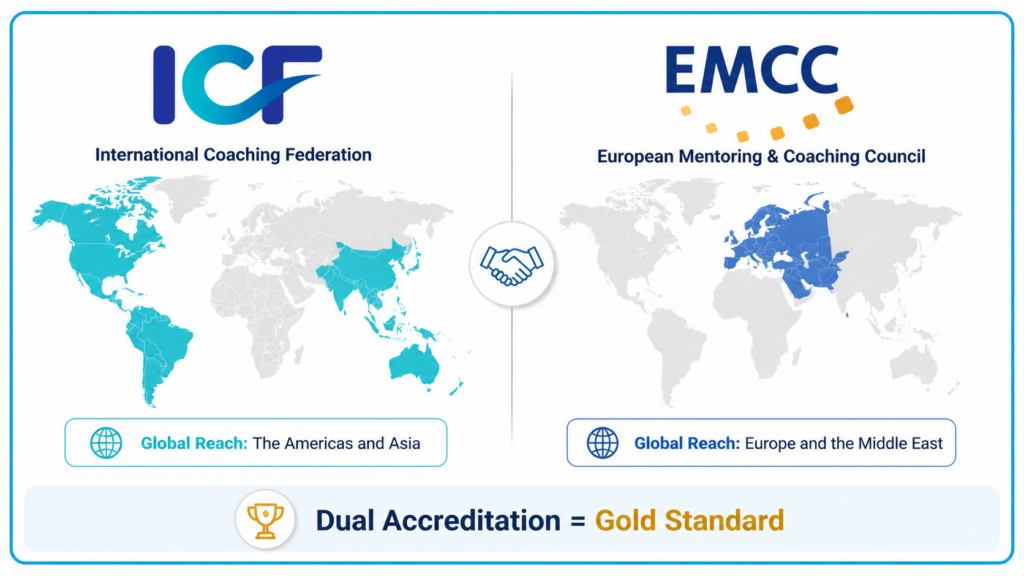
Choose EMCC if: You plan to work in Europe, the UK, the Middle East, or Africa – or if you value the integrated approach to mentoring and supervision.
Choose both (dual-accreditation): This is the gold standard. A school accredited by both bodies gives you maximum global flexibility but higher costs.
➡️ Read our detailed comparison: ICF vs EMCC
Let us talk about money honestly. Coach training comes in different pricing models. Each has pros and cons. Your job is to match the model to your financial situation and risk tolerance.
| Pros | Cons |
|---|---|
| Often includes extensive in-person training | Requires significant upfront savings or a loan |
| May include exam fees and credentialing | High financial risk if you decide coaching is not for you |
| Traditional, well-understood model | Excludes coaches with lower incomes |
Best for: Established professionals with savings, or those whose employer is paying.
| Pros | Cons |
|---|---|
| More affordable than high-end programmes | May not include all practicum hours or mentor coaching |
| Often partially accredited | Watch for hidden fees (exam fees, registration, textbooks) |
Best for: Coaches with moderate savings who want recognised accreditation without the highest price tag.
| Pros | Cons |
|---|---|
| Low upfront cost, pay as you learn | Requires commitment over time (usually 12+ months) |
| Low financial risk if you change career path | Some subscription programmes are not accredited (verify carefully) |
| Accessible to coaches in any country, any income level | Monthly payments can add up over many years if you stay |
Best for: Coaches who want to start immediately without a large lump sum, or who prefer to spread the investment over time.
| Pros | Cons |
|---|---|
| Very low cost | Usually not accredited by EMCC or ICF |
| Quick to complete | Does not lead to professional credential |
| Good for basic skills or curiosity | Not recognised by employers or corporate clients |
Best for: Exploring coaching as a hobby, or adding basic skills to an existing non-coaching role.
When comparing models, look at the total cost to reach your goal.
| If you want… | You will likely pay… |
|---|---|
| A basic certificate (no accreditation) | £200 – £1,000 one-off |
| An accredited diploma (EMCC or ICF) | £3,000 – £15,000 lump sum, or £400 – £800 per year subscription |
| Full credential (e.g., EMCC Senior Practitioner) | £8,000 – £15,000+ total investment across training, practicum, and supervision |
The most important question is not “What is the monthly price?” But:
“what is the accredited outcome I need for my career?”
Regardless of which model you choose, ask every school these questions before you pay:
| Hidden cost | What to ask |
|---|---|
| Exam fees | “Is the final assessment included, or is there an extra fee?” |
| Practicum hours | “Do I need to pay for my own practice clients or supervision?” |
| Textbooks | “Are required materials included or extra?” |
| Credential application | “Does your fee include applying to EMCC or ICF, or is that separate?” |
| Alumni access | “Is ongoing community access included or an extra subscription?” |
| If your total available budget is… | We recommend… |
|---|---|
| Under £500 | Take a short certificate course to explore coaching. Do not expect accreditation. Upgrade later if you commit to the profession. |
| £500 – £3,000 | Look for a monthly subscription model from an EMCC or ICF accredited school. Avoid one-off certificates that claim “accreditation” – verify with the accrediting body first. |
| £3,000 – £8,000 | Compare lump-sum accredited programmes carefully. Ask about hidden fees. Also consider whether a subscription model (£400-£800 per year) gives you the same outcome for less money. |
| £8,000+ | You can afford any school. Prioritise accreditation quality, ongoing support, and alumni community. Ask: “What does the extra £5,000+ actually buy me?” |
There is no single “right” budget model. There is only the model that fits your life, your risk tolerance, and your career goals.
Both formats can deliver excellent accredited training. The best choice depends entirely on your life circumstances.
| Factor | Online Training | In-Person Training |
|---|---|---|
| Flexibility | High – study around work and family. | Low – fixed schedule and location. |
| Networking | Global network, often via platforms like Mighty Networks or Slack. | Local, in-person relationships. |
| Learning Style | Best for self-motivated, independent learners. | Best for those who need accountability and group energy. |
| Cost | Generally lower (no venue or travel costs). | Generally higher (travel, accommodation, venue). |

If you are juggling a full-time job and family, an online, flexible programme is not a compromise; it is the only realistic path. The best online programmes offer live cohort sessions, recorded content, and robust community platforms.

Let us put your answers together. Take 30 seconds to work through the quiz below.
You have taken the quiz and received your personalised recommendation. That recommendation is based on the goals, schedule, budget, and learning preferences you shared.
Now, regardless of which result you received, here are three actions that will move you forward.
Before you invest any money, verify that any school you consider is genuinely accredited by EMCC (European Mentoring & Coaching Council) or ICF (International Coaching Federation).
| How to verify | What to look for |
|---|---|
| Visit the accrediting body’s website | EMCC has a “Find an Accredited Provider” directory |
| Search for the school’s name | ICF has a “Search for an Accredited Coach Education Programme”. |
| Look for the logo on the school’s footer | A real logo links to the accrediting body’s verification page |
If a school claims accreditation but is not listed on EMCC or ICF’s official directories, walk away.
Open a spreadsheet or a notebook. List the schools you are considering side-by-side.
| What to compare | Why it matters |
|---|---|
| Total cost to completion | Lump sum vs. monthly subscription vs. hidden fees |
| What is included | Practicum hours, mentor coaching, assessment fees, textbooks |
| What happens after graduation | Alumni access, CPD, supervision, credentialing support |
| Cancellation policy | Can you pause? Cancel early? Get a refund? |
Do not compare only the monthly price. Compare the total accredited outcome.
No website can answer your specific situation perfectly. Every school should offer a no-obligation conversation.
| Questions to ask on the call | Why these questions matter |
|---|---|
| “What percentage of your graduates earn EMCC or ICF credentials?” | Proves the programme delivers what it promises. |
| “Can I speak to a current student or recent graduate?” | Unfiltered truth about workload, support, and outcomes. |
| “What happens if I need to pause my studies?” | Life happens. Know your options before you enrol. |
A legitimate accredited school will say yes to all three requests. A school that hesitates is hiding something.
If you have taken the quiz, read the comparisons, and still feel uncertain, you are not alone. Most prospective coaches feel the same way. Here is how to break the indecision.
Give yourself 48 hours. Do not research. Do not compare. Do not ask for more opinions.
After 48 hours, ask yourself one question:
“If I do nothing, where will I be in 12 months?”
If the answer is “still stuck, still researching, still not coaching,” then you have your answer. Indecision is a decision. It is the decision to stay where you are.
Many accredited schools offer a low-cost or free introductory module, workshop, or taster session.
| What to look for | What to avoid |
|---|---|
| A live session with a real trainer | Automated, pre-recorded sales presentations |
| Access to a sample lesson or module | High-pressure “enrol today for a discount” tactics |
| A clear week-by-week syllabus | Vague promises about “transformation” with no curriculum |
You do not need to commit to a full programme to test whether coaching training is right for you.
Download the list below. Check every box before you give any school your money.
Coaching Minds Global is an EMCC-accredited coaching school on a mission to make coaching affordable and accessible across the globe.
Our programmes start at £37 per month with no lump sum, no hidden fees, and a global alumni community.
You can contact us on WhatsApp via message or call, and we will be happy to answer any questions you may have.
Or continue your research. Either way, we wish you well on your coaching journey!

We use some essential cookies to make this site work. We'd like to set analytics cookies to understand how you use this site. We may use services from Vimeo and YouTube, which may also use cookies. Cookie Policy
Required for the website to function. Cannot be disabled.
Help us understand how visitors interact with the website.
No analytics cookies are used on this site.
Used to deliver relevant advertisements and track campaigns.
No marketing cookies are used on this site.
Remember your settings and preferences for a better experience.
No preference cookies are used on this site.

