

If you are serious about coaching, you have likely encountered the term “EMCC Accreditation.” But what does it actually mean? And why should you care? In this guide, I will explain everything you need to know about EMCC accreditation, from the different types available to why it matters for your coaching career.
Whether you are a new coach exploring training options or an experienced practitioner seeking advanced credentials, this guide will give you the clarity you need. For a complete overview of how to choose the right coaching school, read our full guide:

EMCC stands for the European Mentoring and Coaching Council. Founded in 1992, it is one of the three largest professional bodies for coaching and mentoring globally, alongside the ICF (International Coaching Federation) and the AC (Association for Coaching).
EMCC is headquartered in Brussels but operates worldwide, with a particularly strong presence in Europe, the Middle East, and Africa. The organisation is known for its rigorous standards, its integration of mentoring and coaching, and its emphasis on supervision and ethical practice.
Many coaches confuse the two distinct types of EMCC accreditation. Understanding the difference is essential for your career planning.
This is school-level accreditation. EMCC accredits training providers, not individual coaches.
| Accreditation Type | What It Covers |
|---|---|
| EQA (European Quality Award) | Coaching or mentoring training programmes |
| ESQA (Supervision Quality Award) | Supervision training programmes |
| TCQA (Team Coaching Quality Award) | Team coaching training programmes |
| PMQA (Programme Manager Quality Award) | Programme management training |
When a coaching school says “EMCC accredited,” they typically mean their programme has been awarded EQA status. This means EMCC has audited the school’s curriculum, trainer qualifications, assessment methods, and ethical standards.
For you, the student: Graduating from an EQA-accredited programme is the standard pathway to applying for individual EMCC credentials.

This is coach-level accreditation. EMCC accredits individual coaches based on their training, experience, and demonstrated competence.
| Accreditation Level | What It Signifies |
|---|---|
| Foundation | Entry-level coach (typically 40-60 training hours, no practicum required) |
| Practitioner | Working coach with proven competence (typically 60-90 training hours, 50-100 client hours) |
| Senior Practitioner | Experienced coach with deep practice (typically 120+ training hours, 300+ client hours) |
| Master Practitioner | Master-level coach with significant impact (typically 200+ training hours, 1000+ client hours) |
Individual accreditation is portable. It stays with you regardless of which school you attended.
| Reason | Explanation |
|---|---|
| Quality assurance | EMCC has audited the school’s curriculum, trainers, and ethics. You are not guessing. |
| Pathway to credential | Most individual EMCC credentials require graduation from an accredited programme. |
| Employer recognition | Corporate clients and organisations increasingly require accredited training. |
| Global mobility | EMCC recognition spans Europe, the Middle East, Africa, and beyond. |
| Supervision requirement | EMCC embeds supervision into its standards, which many experts consider essential for ethical practice. |
The bottom line: Programme accreditation protects your investment. It ensures your training meets a recognised standard.
Not all accredited programmes are equal. Here is what to check before you enrol:
| Factor | Questions To Ask |
|---|---|
| EQA level | Is the programme awarded EQA at Foundation, Practitioner, or Senior Practitioner level? |
| Practicum hours | How many supervised coaching hours are included? |
| Mentor coaching | Is mentor coaching provided? How many hours? |
| Assessment method | How is competence demonstrated? (e.g., recorded sessions, written reflections, live observation) |
| Supervision | Is supervision included or signposted? |
| Articulation to individual accreditation | Does the school provide letters of attendance required for EIA application? |
A transparent school will answer every question. A school that hesitates is hiding something.

Do not trust logos on websites. Verify directly with EMCC.
| Step | Action |
|---|---|
| 1 | Go to the official EMCC Global website: www.emccglobal.org |
| 2 | Navigate to “Find an Accredited Provider” or “EQA Search” |
| 3 | Search for the school’s name |
| 4 | If the school appears in the search results, they are genuinely accredited. If not, they are not. |
If a school claims EMCC accreditation but is not listed in the official directory, walk away.
While this guide focuses on EMCC, many coaches ask how it compares to ICF. Here is a simple summary:
| Factor | EMCC | ICF |
|---|---|---|
| Focus | Coaching, mentoring, supervision | Coaching (primarily) |
| Primary region | Europe, Middle East, Africa | Americas, Asia |
| Supervision requirement | Required for most credentials | Required for PCC and MCC (recent change) |
| Credential levels | 4 levels (Foundation to Master) | 3 levels (ACC, PCC, MCC) |
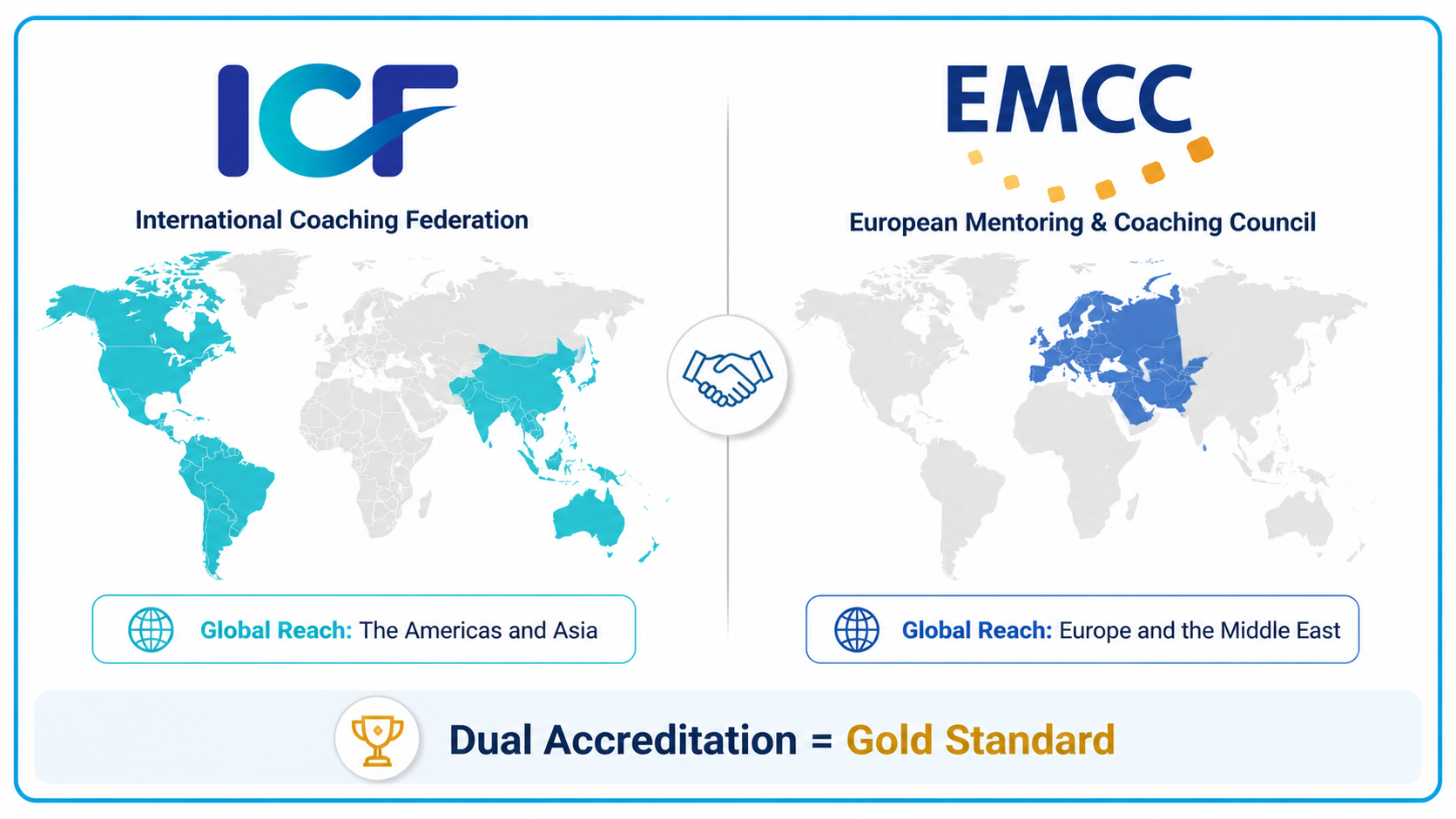
Neither is “better.” The right choice depends on your target market and career goals. For maximum flexibility, consider a school with dual accreditation (both EMCC and ICF).
| Myth | Reality |
|---|---|
| “EMCC is only for European coaches.” | ❌ False. EMCC accredits schools and coaches worldwide. |
| “EMCC accreditation is easier to get than ICF.” | ❌ False. Both bodies maintain rigorous, comparable standards. |
| “Once accredited, always accredited.” | ❌ False. Programmes must renew accreditation every few years. Check the status. |
| “Any coaching certificate is EMCC accredited.” | ❌ False. Verify through the official directory. Do not trust logos. |
Choose EMCC if:
You plan to work in Europe, the Middle East, or Africa
You value the integration of mentoring and supervision
You want a clear pathway from Foundation to Master level
Your target corporate clients recognise EMCC standards
Consider ICF (or dual accreditation) if:
You plan to work primarily in the Americas or Asia
Your target clients specifically request ICF
The gold standard: Graduate from a dual-accredited school (EMCC and ICF). This gives you maximum global flexibility. Alternatively, find two affordable schools offering EMCC and ICF through different programmes.
A: Typically 3-5 years. Schools must reapply and be re-evaluated to maintain their status.
A: In some cases, yes – via a portfolio route. However, this is more complex, slower, and less certain than graduating from an accredited programme.
A: Accredited programmes often cost more than non-accredited ones, reflecting the rigour of the training and the value of the credential. However, affordable accredited options exist (e.g. monthly subscription models from £37 per month).
A: EQA is programme accreditation (school-level). EIA is individual coach accreditation (personal credential). Most coaches do both: train at an EQA-accredited school, then apply for EIA.
A: Yes. EMCC accredits both in-person and online programmes, provided they meet the same quality standards.
If you are considering EMCC Accredited training, here is what to do now:
| Step | Action |
|---|---|
| 1 | Visit the EMCC Global website and explore the “Find an Accredited Provider” directory |
| 2 | Shortlist 3-5 accredited programmes that fit your budget and schedule |
| 3 | Ask each school the questions from the “What To Look For” section above |
| 4 | Speak to a current student or recent graduate |
| 5 | Trust your research and make a decision |
Paul L. Smith is an EMCC Senior Practitioner and Managing Director of Coaching Minds Global, an EMCC Accredited coaching school. With over nine years of experience in coaching and mentoring, Paul has helped hundreds of coaches achieve accreditation and build successful practices.
We use some essential cookies to make this site work. We'd like to set analytics cookies to understand how you use this site. We may use services from Vimeo and YouTube, which may also use cookies. Cookie Policy
Required for the website to function. Cannot be disabled.
Help us understand how visitors interact with the website.
No analytics cookies are used on this site.
Used to deliver relevant advertisements and track campaigns.
No marketing cookies are used on this site.
Remember your settings and preferences for a better experience.
No preference cookies are used on this site.