
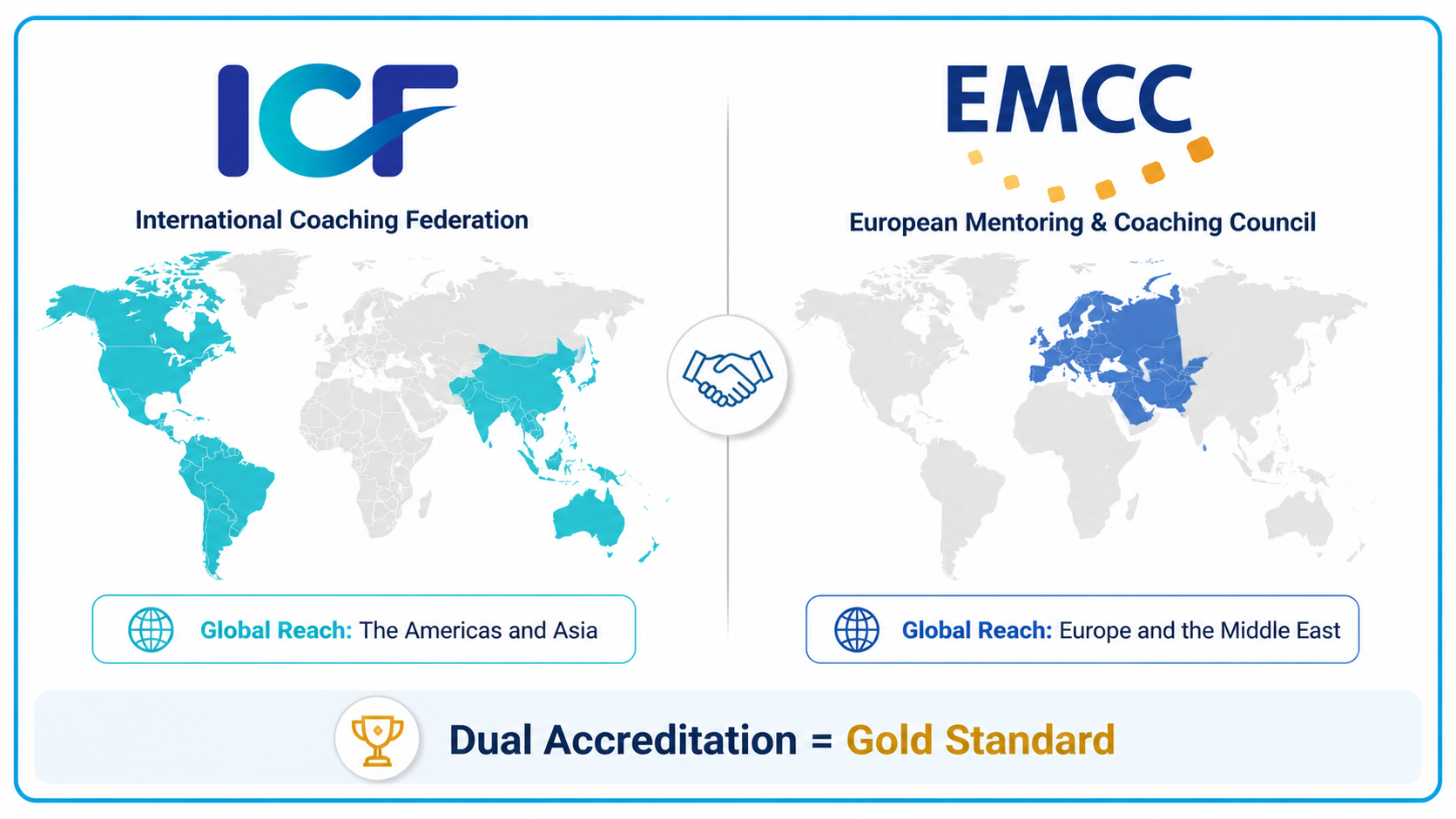
If you are researching coach training, you have likely encountered two names repeatedly: ICF (International Coaching Federation) and EMCC (European Mentoring and Coaching Council). Both are respected. Both are rigorous. Both can lead to a successful coaching career. But they are not the same.
Choosing between them is not about finding the “better” organisation. It is about finding the right fit for your target market, your career goals, and your coaching philosophy. In this guide, we will compare ICF and EMCC across every factor that matters: global reach, credential levels, supervision requirements, cost, and reputation. By the end, you will know exactly which path (or whether dual accreditation) is right for you.
For a complete overview of how to choose the right coaching school, including accreditation, budgets, and learning formats, read our full guide:

The International Coaching Federation (ICF) was founded in 1995 (previously ICC between 1991 and 1995) and is headquartered in the United States. It is the largest coaching body in the world, with over 50,000 members across more than 160 countries.
ICF is best known for its core competencies – a defined set of coaching skills and ethical standards that form the backbone of its training and credentialing programmes. ICF focuses exclusively on coaching (not mentoring or supervision, though supervision is now required for higher credentials).
ICF has a particularly strong presence in the Americas and Asia-Pacific regions. If your target clients are based in the United States, Canada, Latin America, Australia, or Japan, ICF is often the expected credential.
The European Mentoring and Coaching Council (EMCC) was founded in 1992 and is headquartered in Brussels, Belgium. It operates globally, with a particularly strong presence in Europe, the Middle East, and Africa.
EMCC is distinctive because it integrates mentoring and supervision as essential pillars of professional practice, not optional extras. The organisation offers separate accreditation pathways for coaches, mentors, supervisors, and training providers.
EMCC’s philosophy emphasises that coaching does not happen in isolation. Regular supervision and reflective practice are embedded into its standards, which many experts consider the gold standard for ethical, sustainable coaching practice.
Here is a detailed comparison across the factors that matter most to your career.
| Factor | ICF | EMCC |
|---|---|---|
| Founded | 1995 (1991 ICC) | 1992 |
| Headquarters | Lexington, Kentucky, United States | Brussels, Belgium |
| Primary Regions | Americas, Asia-Pacific | Europe, Middle East, Africa |
| Members/credential Holders | 50,000+ | 10,000+ (individuals) plus accredited programmes |
| Credential Levels | 3 (ACC, PCC, MCC) | 4 (Foundation, Practitioner, Senior Practitioner, Master) |
| Focus | Coaching | Coaching, mentoring, supervision |
| Supervision Requirement | Required for PCC and MCC (recent change) | Required for all levels beyond Foundation |
| Training Hours (typical) | ACC: 60+ hours; PCC: 125+ hours; MCC: 200+ hours | Practitioner: 60-90 hours; Senior: 120+ hours; Master: 200+ hours (plus years of experience) |
| Client Hours (typical) | ACC: 100+; PCC: 500+; MCC: 2,500+ | Practitioner: 50-100; Senior: 300+; Master: 1000+ |
| Renewal Requirements | Continuing education every 3 years | Continuing professional development plus supervision |
| If you plan to work in… | The stronger credential is… |
|---|---|
| United States, Canada, Latin America | ICF |
| Australia, New Zealand, Japan, Singapore | ICF (strong presence) |
| United Kingdom, Ireland | EMCC (very strong) or ICF |
| Mainland Europe (Germany, France, Netherlands, etc.) | EMCC (dominant) or ICF (growing) |
| Middle East (UAE, Saudi Arabia, Qatar) | EMCC (strong) |
| Africa (South Africa, Nigeria, Kenya) | EMCC (strong) |
| India | Both (ICF has larger numbers, EMCC growing) |
The bottom line: If you know exactly where you want to work, choose the body dominant in that region. If you want global flexibility, dual accreditation is the gold standard.
EMCC has required supervision for all credential levels beyond Foundation for many years. ICF recently introduced supervision requirements for PCC and MCC.
| Why this matters | Explanation |
|---|---|
| EMCC’s long-standing supervision requirement | EMCC-aligned coaches are typically more experienced with reflective practice and ethical case discussion |
| ICF’s newer supervision requirement | Many ICF-trained coaches are still adapting to supervision |
| Your preference | If you value regular structured reflection, EMCC’s approach may feel more natural. If you prefer less ongoing requirement, ICF may feel lighter (though this is changing). |
ICF distinguishes between mentor coaching (focused on developing coaching skills) and supervision (focused on ethical case reflection and coach wellbeing). Both are required at different credential levels.
EMCC integrates these more holistically, with supervision expected to cover both skill development and ethical case reflection.
Neither approach is better. They reflect different philosophical traditions.
You plan to work primarily in the Americas or Asia-Pacific
Your target corporate clients specifically request ICF credentials
You prefer a coaching-only focus (without mandatory mentoring/supervision integration)
You want access to the largest global network of coaches
You plan to work primarily in Europe, the Middle East, or Africa
You value the integration of mentoring and supervision as essential to ethical practice
You want a clear pathway from Foundation to Master level
Your target clients (e.g., European corporates, international organisations) recognise EMCC standards
You want maximum global flexibility
You plan to work internationally or with multinational clients
You are willing to invest the additional time and cost to hold both credentials
You want to be credentialled with both of the world’s leading bodies
| Myth | Reality |
|---|---|
| “ICF is better than EMCC.” | ❌ False. Both maintain rigorous, comparable standards. Neither is “better.” |
| “EMCC is only for European coaches.” | ❌ False. EMCC accredits coaches and schools worldwide, with strong presence in the Middle East and Africa. |
| “ICF credentials are easier to get.” | ❌ False. Both require significant training, client hours, and assessment. |
| “You cannot hold both credentials.” | ❌ False. Many senior coaches maintain both ICF and EMCC credentials. |
| “One is cheaper than the other.” | ⚠️ Partially true. Costs vary by credential level and training provider. Compare specifics. |
A: Yes. Many senior coaches maintain both. This is often called "dual accreditation." It requires meeting the training, client hour, and supervision requirements of both bodies.
A: It depends on the employer. US-based corporations often prefer ICF. European-based corporations often prefer EMCC. Multinationals with global operations increasingly accept both.
A: No. You can earn ICF credentials after training at an ICF-accredited school, and EMCC credentials after training at an EMCC-accredited school. A school with dual accreditation (both ICF and EMCC) gives you the most flexibility.
A: ICF has more individual credential holders (50,000+). EMCC has fewer individual credential holders (10,000+) but a robust programme accreditation system (EQA) that accredits training providers across dozens of countries.
A: Both bodies charge similar fees for credential applications and renewals (typically $100-500 USD/EUR depending on level). The larger cost is the training itself, which varies by school, not by accrediting body.
If you are deciding between ICF and EMCC, here is what to do now:
| Step | Action |
|---|---|
| 1 | Identify your target client market (geography and sector) |
| 2 | Research which credential is more recognised in that market |
| 3 | Shortlist accredited training providers that offer the credential you need |
| 4 | Ask each school if they offer dual accreditation (both ICF and EMCC) |
| 5 | Speak to a current student or recent graduate of each programme |
*Still unsure which path is right for you? Take our 30-second quiz to get a personalised recommendation based on your goals, budget, and schedule ➡️ Complete Guide to Finding the Best Coaching School
Paul Smith is an EMCC Senior Practitioner and Managing Director of Coaching Minds Global, an EMCC accredited coaching school. He has helped hundreds of coaches achieve accreditation and build successful practices. Coaching Minds Global offers a pathway to EMCC accreditation through its affordable monthly subscription model.
We use some essential cookies to make this site work. We'd like to set analytics cookies to understand how you use this site. We may use services from Vimeo and YouTube, which may also use cookies. Cookie Policy
Required for the website to function. Cannot be disabled.
Help us understand how visitors interact with the website.
No analytics cookies are used on this site.
Used to deliver relevant advertisements and track campaigns.
No marketing cookies are used on this site.
Remember your settings and preferences for a better experience.
No preference cookies are used on this site.